
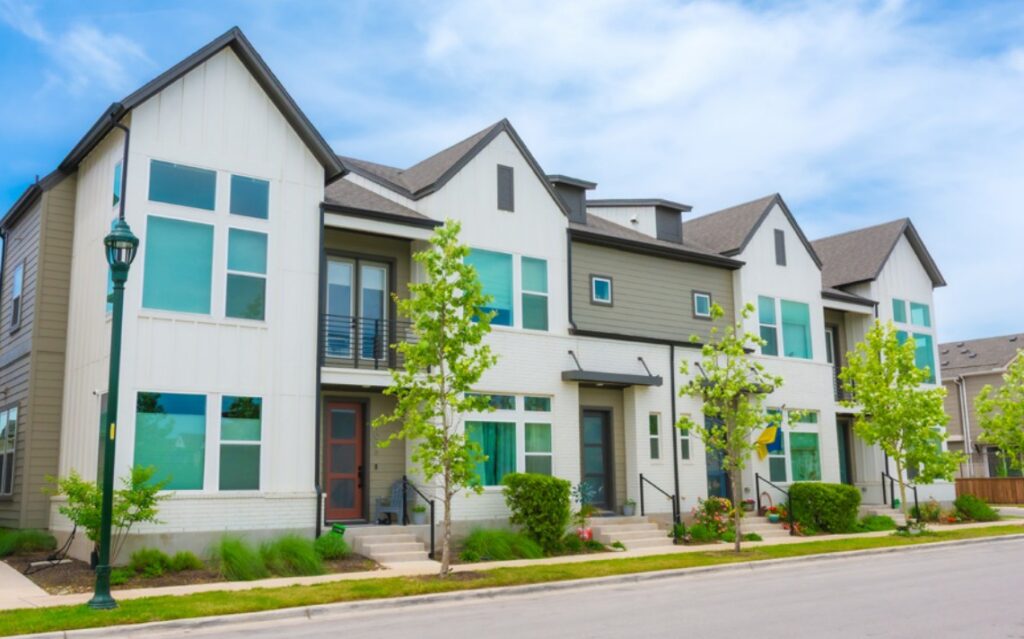
This week, City Council passed a resolution to initiate amendments to the Land Development Code (LDC) to create new missing middle and mixed-use base zoning districts — a step toward enabling more housing variety and less car dependence across Austin.
What is “Missing Middle”?
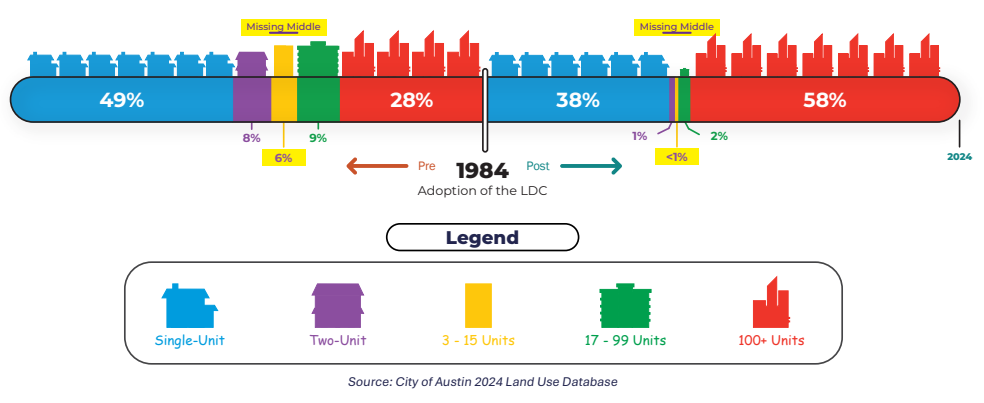
According to Austin Planning’s Missing Middle and Mixed-Use Zoning Study completed in January, Austin’s existing base zoning largely limits housing to two extremes: single-family homes or large apartment complexes. Just 3% of Austin’s current housing stock is in the missing middle range of 3-16 units — think townhomes, cottage courts, fourplexes, and small multi-unit buildings that promote walkable, transit-oriented neighborhoods.
Why are they missing? Mid-20th century zoning laws — including Austin’s own Land Development Code, adopted in 1984 — effectively banned these housing types in most residential areas through minimum lot sizes, single-family-only zoning, parking minimums, and setback requirements. The graphic below, from the study, illustrates how dramatically Austin’s housing mix shifted after 1984:
This push for more missing middle housing has been a long time coming. Multiple city-adopted plans have called for allowing more housing types in more places, including the Imagine Austin Comprehensive Plan (2012), the Austin Strategic Housing Blueprint (2017), and the Austin Strategic Mobility Plan (2019).
The ill-fated LDC overhaul known as CodeNext was supposed to address all of this — but a decade later, with the same code still in place, there finally appears to be enough political will to make meaningful changes.
What’s Proposed?
Missing Middle
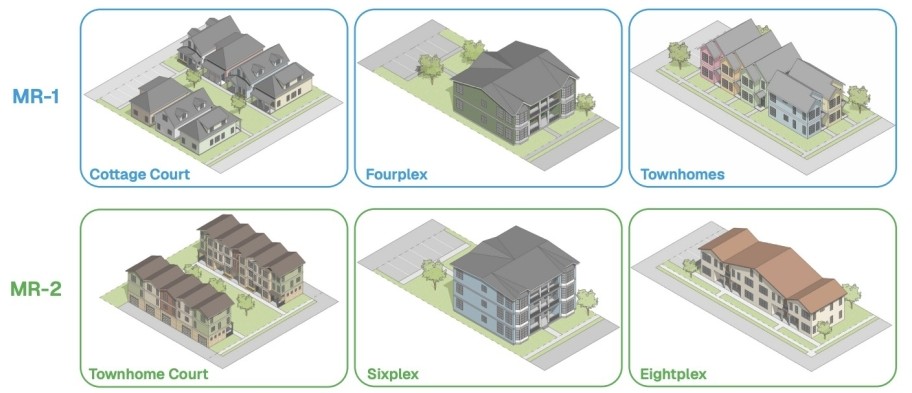
City Manager TC Broadnax is tasked with creating new base zoning districts to allow for more housing types. The study proposes two new districts — MR-1 and MR-2 — though the details are still being finalized. The illustration below shows what these could look like on a standard residential lot:
Mixed-Use
Beyond new housing types, the resolution also calls for new mixed-use base zoning districts that would allow residential, commercial, and office uses to coexist on a single property. The goal is to create more walkable, less car-dependent neighborhoods — reducing urban sprawl and infrastructure costs in the process.
Mixed-use development is already permitted in Austin through tools like Mixed Use (-MU) combining districts, Planned Unit Developments (PUDs), and regulating districts such as TODs, North Burnet/Gateway, and East Riverside Corridor. Most recently, Senate Bill 840 (2025) allows multifamily or mixed-use residential development on any property already zoned for commercial, office, retail, or warehouse uses.
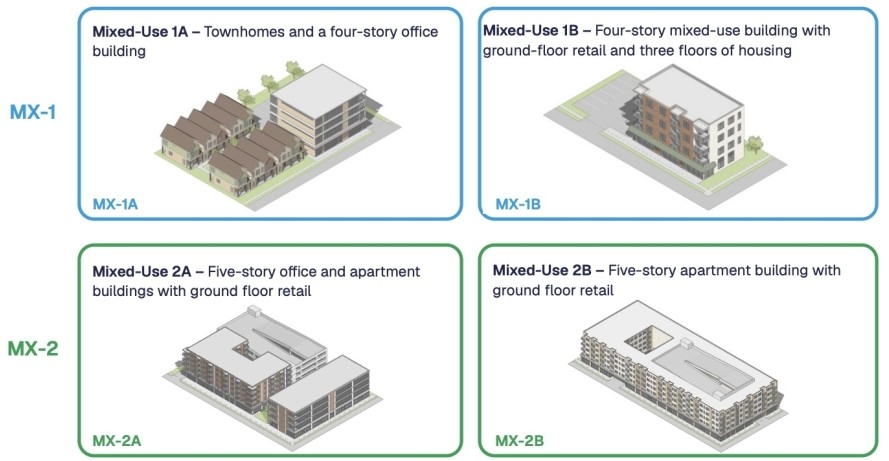
The new base districts would build on this momentum, with a particular focus on supporting transit-oriented development. Here’s what they could look like:
What Happens Next?
City staff will develop the new zoning districts and present them to City Council for approval no later than March 2027. Expect a robust public engagement process in the months leading up to that vote.